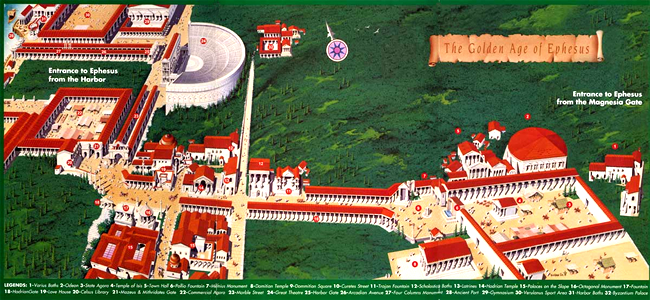
Where is Ephesus, Ephesus location The ancient city of Ephesus near the
modern town of Selcuk, about 50 km south of Izmir (Smyrna) in
Turkey.
Location: Ephesus was constructed on a river
bend, that was eventually dredged into a full harbor near the
mouth of the Cayster River, on the western coast of Asia Minor
(modern Turkey). Along the coastal plain between Smyrna to the
north and Miletus to the south, the site is now about six miles
from the Aegean Sea. The city shifted in five distinct locations
over time, each within a small area.
The Apostles Paul and John were familiar with the city that
scholars have dubbed "Ephesus III" the largest (in area) of the
five.
The areas where Ephesus located are as follows: Ephesus I: Aya Suluk (St. John Area) Ephesus II: Artemission area Ephesus III: Port of St. Paulbase of
Mount Koressos Ephesus IV: north of Aya Suluk Ephesus V: Seljuk area
Because of the man-made harbor structure and the flow of the
river, a backwash flow caused the harbor to frequently silt up
(by 449 BCE we already read of problems
documented about the silting. Later, Eusebius records that
Ephesus honored Emperor Hadrian for dredging and making
navigable the harbor). When cleared, Ephesus was in a location
that justified a great seaport. The city sat at the convergence
of three land routes with a shipping lane from the north via the
channel created by the Island of Chios and an opening facing the
cities of Macedonia.
The land routes that converged on
Ephesus included: 1) The Colossae / Laodicea road (travelling
east), 2) The road to Sardis and Galatia (northeast),
and 3) The Smyrna (north) main road.
Ephesus is discovered in Selcuk, Izmir in western Turkey.
Kusadasi is 19 km. far away from Ephesus and Pamucak beach is 5
km far away from Ephesus.
The original site of Ancient Ephesus was most likely established
on the Aegean coast, on the shores of that sea which is today
located 8 km. away from the archaeological excavations.
Over the centuries, in fact, the rubble brought on to the plain
of the "Kucuk Menderes" has enlarged the
alluvial plain surrounding the archaeological zone, leaving
behind in actual fact the shores of the Aegean. In Roman times
it was situated on the northern slopes of the hills
Coressus and Pion and south of the
Cayster (Kucuk Menderes)
River, the silt from which has since formed a fertile plain but
has caused the coastline to move ever farther west. In Roman
times a sea channel was maintained with difficulty to a harbor
well west of Pion. By late Byzantine times this channel had
become useless, and the coast by the mid-20th century was three
miles farther west.
Ephesus (Efes) is close to the town of Selcuk about an hour
drive south of Izmir. Kusadasi is the nearest larger town, about
20km from Ephesus. Ephesus is discovered in Selcuk, Izmir in
western Turkey.
Kusadasi is 19 km. far away from Ephesus and
Pamucak beach is 5 km far away from Ephesus.
The original site of Ancient Ephesus was most likely established on the Aegean
coast, on the shores of that sea which is today located 8 km.
away from the archaeological excavations. Over the centuries, in
fact, the rubble brought on to the plain of the "Kucuk Menderes"
has enlarged the alluvial plain surrounding the archaeological
zone, leaving behind in actual fact the shores of the Aegean. In
Roman times it was situated on the northern slopes of the hills
Coressus and Pion and south of
the Cayster (Kucuk Menderes) River, the silt from which has
since formed a fertile plain but has caused the coastline to
move ever farther west. In Roman times a sea channel was
maintained with difficulty to a harbor well west of Pion.
By late Byzantine times this channel had become useless, and the
coast by the mid-20th century was three miles farther west. Ephesus (Efes) is close to the
town of Selcuk about an hour drive south of Izmir. Kusadasi is
the nearest larger town, about 20km from Ephesus.
Ephesus Location: Ephesus was constructed on a
river bend, that was eventually dredged into a full harbor near
the mount of the Cayster River, on the western coast of Asia
Minor (modern Turkey). Along the coastal plain between Smyrna to
the north and Miletus to the south, the site is now about six
miles from the Aegean Sea. The city shifted in five distinct
locations over time, each within a small area. The Apostles Paul
and John were familiar with the city that scholars have dubbed
"Ephesus III" the largest (in area) of the five.
The areas where Ephesus located on as follows: Ephesus I: Aya Suluk (St. John Area) Ephesus II: Artemission area Ephesus III: Port of St. Paul: base of Mount Koressos Ephesus IV: north of Aya Suluk Ephesus V:Selcuk area
The land routes that converged on Ephesus included
1) The Colossae / Laodicea road (traveling
east) 2) The road to Sardis and Galatia (northeast)
3) The Smyrna (north) main road. Population:
Some scholars estimate the number of people living at Ephesus to
have exceeded 250,000 inhabitants during. Ephesus III, which would make it perhaps the
fourth largest of its day behind: 1) Rome 2) Alexandria 3) An Antioch.
This large a city was an economic stronghold in Asia Minor, and
justified the title supreme metropolis of Asia though there is
an evidence that its overall economic standing may have been
slowly declining.