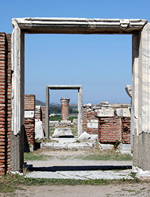
Welcome to
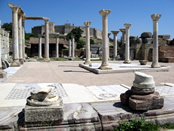
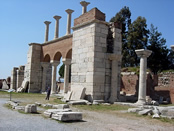
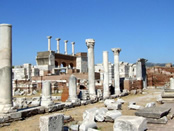 constructed for protection from the Arabian attracts in the 7th
- 8th centuries AD. The impressive 10th century AD frescoes
representing St John, Jesus and a Saint,
ornament the chapel.
constructed for protection from the Arabian attracts in the 7th
- 8th centuries AD. The impressive 10th century AD frescoes
representing St John, Jesus and a Saint,
ornament the chapel. 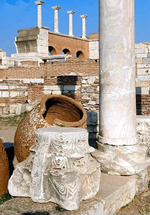 o
the Fourth Gospel, also known as the Gospel of John (In
19:26-27), on the cross:
o
the Fourth Gospel, also known as the Gospel of John (In
19:26-27), on the cross: 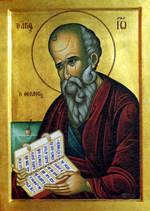
 reason
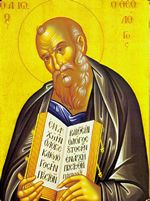
of its aridity completely barren', St. John was
exiled to Patmos together with his young
disciple Prochorus, one of the deacons of the
Jerusalem church (Acts 6:5). On the way to
Patmos he rescued a boy who fell from the ship
into the sea. The length of his exile is claimed to have been
one and half, or five or fifteen years. During his stay there he
did not stop preaching the Gospel and converting the
inhabitants. A tradition has it that when his activity was heard
at the Temple of Apollo, the priests asked help
from a famous magician called Kynops whose most
popular trick was to jump into the sea and come out after a
while, unharmed. In front of the witnesses challenging St. John,
he did the same. St. John extended his arms in the form of a
cross and prayed '0 Thou, who didst grant to Moses by this
similitude to overthrow the Amalek, 0 Lord Jesus Christ, bring
down Kynops to the deep of the sea; let him
never more behold this sun, nor converse with living men', After
a short while the petrified body of the magician surfaced as a
rock on the water a short distance away. The local fishermen
claim that to this day the bad taste of the shellfish caught
around the rock derives from this magician. On Patmos
St. John was unchained and free to go wherever he
wished. It was in a grotto on Patmos that he
wrote the Fourth Gospel and received the visions of the last
book of the New Testament known as the Book of
Revelation. Some of the imagery, for instance:
reason
of its aridity completely barren', St. John was
exiled to Patmos together with his young
disciple Prochorus, one of the deacons of the
Jerusalem church (Acts 6:5). On the way to
Patmos he rescued a boy who fell from the ship
into the sea. The length of his exile is claimed to have been
one and half, or five or fifteen years. During his stay there he
did not stop preaching the Gospel and converting the
inhabitants. A tradition has it that when his activity was heard
at the Temple of Apollo, the priests asked help
from a famous magician called Kynops whose most
popular trick was to jump into the sea and come out after a
while, unharmed. In front of the witnesses challenging St. John,
he did the same. St. John extended his arms in the form of a
cross and prayed '0 Thou, who didst grant to Moses by this
similitude to overthrow the Amalek, 0 Lord Jesus Christ, bring
down Kynops to the deep of the sea; let him
never more behold this sun, nor converse with living men', After
a short while the petrified body of the magician surfaced as a
rock on the water a short distance away. The local fishermen
claim that to this day the bad taste of the shellfish caught
around the rock derives from this magician. On Patmos
St. John was unchained and free to go wherever he
wished. It was in a grotto on Patmos that he
wrote the Fourth Gospel and received the visions of the last
book of the New Testament known as the Book of
Revelation. Some of the imagery, for instance: