Ephesus history
In the year of 10 BC, Androclos, the son of
King of Athens-Kodros, was searching a location
for establishing a site. Androclos belonged to
Akhas, was running from the Door invasion in
Greece. He was leading one of the migration
convoys. It was predicted by an Apollon
oracle that a fish and a boar would show the location
of the new settlement.
Days later, parallel to the oracle’s prediction, while frying, a
fish fell down from the pan, irritating a hiding boar behind the
bushes. The feared boar escaped immediately. Androclos
followed the boar and established the city of Ephesus, where he
had killed the boar. When Androclos died in the
wars with Carians, a mausoleum was built to the
memory of the first king of Ephesus. The mausoleum is considered
to be placed around "The Gate of Magnesia".
Ephesus was ruled by the Lydian king,
Kreisos, in the mid 6BC. The city
reached the "Golden Age" and became a good
model to the Antic World in culture and art, as well.
As the detailed excavations have not completed yet, apart from
the Artemis, the remains of that age haven’t
been revealed. Later, Ephesus was dominated by
Persians. As Ephesians did not join the "Ionian
Rebellion" against Persians, the city was saved from
destruction. The rebellion resulted in the loss of
Persian. Alexander the Great won
Persians and the Ionian cities got their
independence in the year of 334. Ephesus was in great prosperity
during the times of Alexander the Great Until
the arrival of Alexander the Great,
Ephesus was consisted of two governing systems,
democratic and oligarchic. But the oligarchic system was
violated with the coming of a new ruler, and a rebellion existed
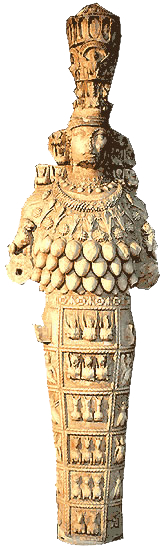
in Ephesus. The Temple of Artemis
was fired and destroyed by the supporters of oligarchy in
356 BC.
But it is believed that a madman known as Herostratus
set fire to the temple in order to make his name immortal on the
same night in MacedoniaAlexander the
Great was born. As the temple became unusable,
Alexander the Great proposed for repairing. But the
Ephesians delicately refused for the reason
that "A God can not built a temple for another God.".So
Alexander
who was very proud of himself as a God, gave some special
privileges to the city. An Ephesian architect,
Dinocrates restored the Temple of
Artemis. After the death of Alexander the Great, Ephesus
was ruled by the general of him, Lysimachus, in
287 BC.
Lysimachus decided to change the prior location
of Ephesus to further west, due to the
destruction of the port by the alluviums, and the inhabitants
were forced to settle in the new place named "Arsinoeina", the name of
Lysimachus’ wife. The city was surrounded by wide stone
walls in 10 meters height and 9 meters length. And, "Arsinoeina"
was changed into "Ephesus" again, to be
forgotten eternally.